Creating a Morning Routine for a Stronger You

For many of us in midlife, mornings can feel like we are immediately giving to everyone else before we’ve had a moment for ourselves. Between work, family life and everyday responsibilities, carving out time can feel impossible – and even when the intention is there, knowing where to start can feel overwhelming.

One of the biggest challenges I hear from my community is not just making the time, but committing to it consistently. We often place ourselves at the bottom of the list, convincing ourselves we will “find the time later”, when in reality the day quickly takes over.

I’m naturally an early riser, so for me that means waking up around 5am (although I appreciate that may not be for everyone!). But even getting up 30–45 minutes earlier to create time purely focused on you can completely change the tone of your day. Over time, those small moments of consistency begin to build confidence, motivation and resilience.

I truly believe the way we begin the morning impacts how we move through the rest of the day. Starting slowly, intentionally and with movement can help reduce that constant feeling of rushing or reacting to life. Instead, you begin the day feeling calmer, more grounded and better equipped to handle whatever comes your way.

Particularly for those of us in the northern hemisphere, now is the perfect time to take advantage of the lighter mornings and create a routine that works for you. There is something incredibly calming about stepping outside early in the morning before the day fully begins — whether it’s a quiet walk, fresh air with a coffee in hand or simply hearing the birds before the rush starts.

Simplify Your Mornings

Here are some key things I do to help me the night before to organise for the following day:

  • This may sound obvious, but setting out your clothes the night before can mean the difference of getting up and outside or not! Lay out your clothes the night before along with a pair of socks and your trainers.
  • Prep your breakfast – Overnight oats are a great option, or perhaps berries ready for yoghurt and granola, or smashed avocado with olive oil and tomatoes prepared in a container. It is one less thing to think about once the day starts becoming busy.
  • I love a list! Taking five minutes before bed to write out your plans or priorities for the next day makes such a difference. I find it really helps me switch off in the evening and it feels great to wake up prepped for the day ahead.

The Plan

Set a non-negotiable morning plan just for you:

Creating a non-negotiable morning routine for yourself does not need to be complicated. The key is finding something realistic and sustainable that supports both your physical and mental wellbeing.

Embrace the early mornings in a way that feels achievable for you. Start by setting your alarm just 15–30 minutes earlier than usual and see how you feel. Often, our bodies adapt surprisingly quickly once a routine becomes familiar.

Make yourself accountable. Download your workout the night before, arrange to meet a friend for a walk or simply put your trainers on before you have a chance to change your mind.

Before immediately reaching for your phone, give yourself a few quiet moments. Whether it’s a coffee in the kitchen, a large glass of water outside or simply sitting in silence for a minute or two, allowing yourself space before the noise of the day begins can feel incredibly grounding.

I also like to include 10 minutes of mobility work in the morning. Mobility is something many of us overlook, but it can make a huge difference to posture, movement quality and how our bodies feel throughout the day. (You can see my recent mobility routine written for The Telegraph here.)

And of course – walk! According to Oura (I’m loving mine at the moment), we need between 5–20 minutes of sunlight exposure daily depending on the weather. Morning light exposure can help regulate our body clock, improve energy levels and even support better sleep at night. On darker or overcast mornings, simply staying outside for longer can still make a real difference.

Strength training is another essential part of my routine. One of the biggest misconceptions I hear from women is that workouts need to be long or complicated to be effective. In reality, even a focused 30-minute session can help improve strength, boost energy, support bone health and build confidence over time.

30 Minute Body HIIT Workout

I aim for 3–4 strength sessions per week and one of those is usually HIIT-based. Remember, form is everything, so move slowly, stay controlled and work at your own pace.

Warm Up (5 mins)

Do each exercise for 45 seconds:

  • Marching
  • Arm circles
  • Bodyweight squats
  • Toe touches
  • High knees (slow and controlled)

30 seconds work / 30 seconds rest
2 rounds total (rest 1 minute between rounds)

  1. Jumping jacks (or side-to-side steps for low impact)
  2. Mountain climbers (slow and controlled)
  3. Squats
  4. Plank
  5. Wall sit
  6. Reverse lunges (alternate legs)
  7. Push-ups (knees or incline if preferred)
  8. Dead bugs
  9. Glute bridges
  10. High knees (or marching on the spot)

Cool Down (5 mins)

Hold each stretch for approximately 30–40 seconds:

  • Hamstring stretch
  • Quad stretch
  • Child’s pose
  • Chest stretch (doorway stretch)

A Final Thought

Making time for yourself is so important, yet it is often the first thing we sacrifice. Prioritising movement is about so much more than physical health – it supports mood, improves resilience, builds confidence and helps us feel mentally lighter as well as physically stronger.

The hardest part is often simply beginning. But once you start carving out small moments of time for yourself each morning, your body and mind begin to crave it. You do not need a perfect routine or hours of spare time to feel the benefits. Even small moments of movement, fresh air and quiet can have a powerful impact over time.

The goal is not perfection – it is creating a rhythm that helps you feel calmer, stronger and more connected to yourself each day.

And with the brighter mornings and longer days ahead, there really is no better time to begin.

As always, if you have any questions please do get in touch.

Caroline x
Why You Should Never Skip An Arms Day!

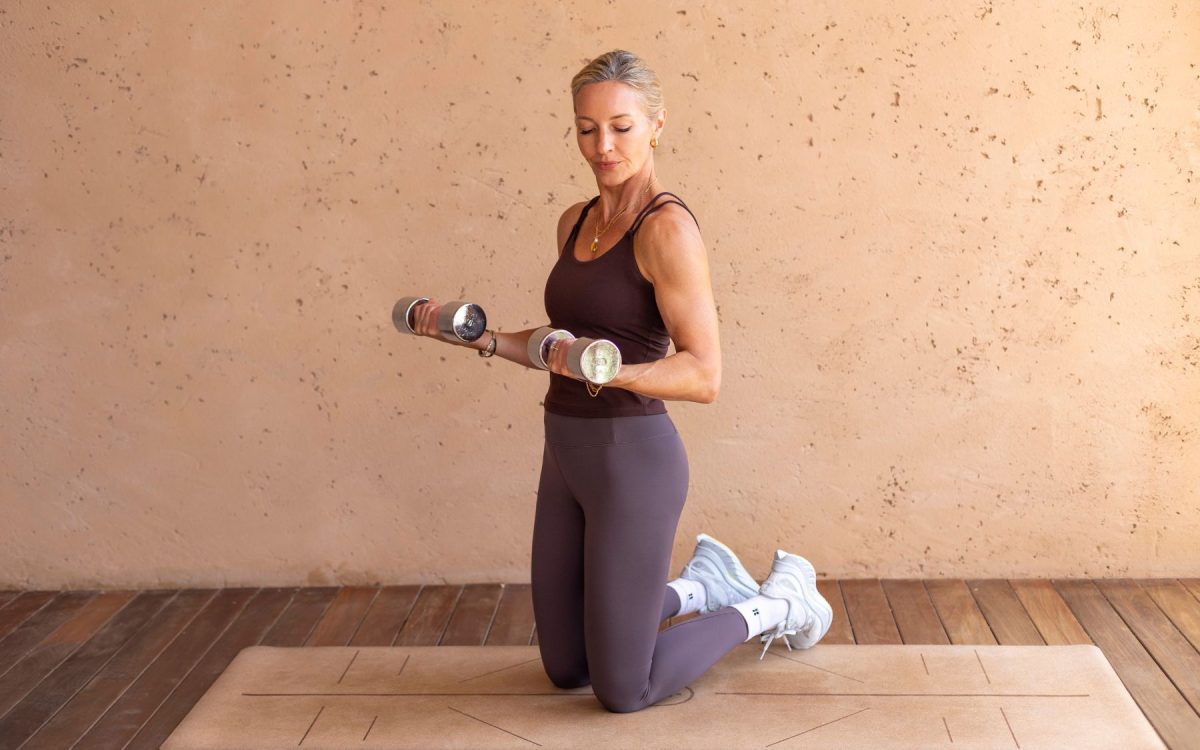
For women in midlife (especially) training our upper body through strength training means a lot more than just “toning our arms!” It supports strength, bone health, posture, metabolism, mobility and long-term independence during a phase when hormonal changes accelerate muscle and bone loss. Training my upper body has always been one of my favourite workout days and I really think it’s an area where you can see as well as feel the benefits in a relatively short space of time if you are consistent. It is about building in those small habits that last and strengthening the upper body is so important for our functional daily movements, now and in the future.

What Can I Do To Warm Up/Cool Down My Upper Body?

Before starting your workout, taking just a few minutes to properly warm up your upper body (specifically your back, your shoulders, your core) will make a huge difference. A good warm up helps increase blood flow, improve mobility, activate the muscles and reduce the risk of injury. This is especially important as our joints need more attention as we age, yet it is key at any life stage. This quick upper body warm up will help wake up the shoulders, chest, back, arms and core so you feel more mobile and ready to get the most out of your workout plus support with recovery.

Try each of the below for 30-40 seconds:

  • Arm circles (forward + backward)
  • Shoulder rolls
  • Cat-cow stretches
  • Wall push-ups
  • Torso twists with arm swings
  • Light punches or shadow boxing

What Weights Should I Be Using?

I always encourage using weights that are right for you – this should feel challenging but never painful. Progressive overload is important for building strength and overall fitness. The right weights will always depend on your experience, fitness levels and goals but as a rough guideline for any beginners I suggest starting with 2kg and building up from there and always ensure correct form (I have a “How To” section on my platform that can help you here). Remember that the last 2 or 3 reps of your set should feel a challenge if you are using the correct weights.

What Are My Top 5 Arms/Shoulder Exercises?

These are my go-to Arm/Shoulder exercises that I swear by for building strength, improving tone, and supporting everyday movement. Simple, effective and easy to add into your weekly routine! You can do these as a daily 5 minute routine or repeat the sets for a longer session. Perform these for 40 seconds of work with a 20 seconds rest. 

Shoulder press – targets the shoulders and triceps
Hammer curls – targets the biceps and forearms
Tricep kickbacks – targets the back of the arms (triceps)
Press ups – targets the chest, shoulders, triceps, and core
Lateral raises – targets the shoulders 

How Can I See The Benefits?

A common fear I hear from many women when it comes to strength training and upper body workouts is becoming “too bulky”. This is a myth. Building significant muscle size requires very specific training, nutrition and consistency over time and to get the bodybuilder physique is really not easy. However to build lean muscle you need to focus on a variety of weights, progressive overload and a structured program with both isolated and compound movements such as those I have included here and of course a balanced diet and recovery. If you stay consistent you will see those results.  

A Final Thought

On my platform we focus on all of these elements and keep the workouts varied to ensure we keep challenging the muscles. For the upper body class on a Tuesday, we do some of the workouts with heavier weights for pure strength and power and some with more moderate weights with high reps for endurance which helps develop lean muscle overall. Strength training 3-4 times per week creates a balanced approach to training the entire body while still giving each muscle group the attention and recovery it needs to grow progressively, effectively and safely over time.

As always, any questions please do get in touch

Caroline x 

Your 6 Week Strength Framework!

With 6 weeks to go until Summer you will be bombarded now with Summer workout plans in the media! I wanted in this week’s blog to look at exactly why this time frame can be a motivator especially for those starting out on a fitness journey and how your body will adapt in this time. Six weeks is a useful checkpoint for strength training because several different adaptation timelines start to overlap around then:

  1. your nervous system gets better at lifting
  2. your body starts building measurable muscle
  3. the routine begins to feel psychologically “normal” instead of forced

That combination makes 6 weeks feel like the point where training shifts from “experiment” to “part of your life.” And we know that it is all about building new habits that will last. 

Whilst we are talking about getting stronger for Summer It’s important to remember that this isn’t about chasing a “summer body” – it’s about building strength, improving mobility and creating momentum that lasts beyond one season.

Six weeks is a powerful window as it’s long enough for the body to begin making meaningful changes – especially when prioritising strength and longevity. In the early stages your nervous system starts learning movement patterns more efficiently, coordination improves and light workouts can feel hard work as the brain and body adapt. Repeating the cycle of showing up, completing workouts and experiencing the rewards (feeling stronger, sleeping better and benefiting from positive endorphins!) gradually turns exercise from something you have to think about into a natural part of your daily routine.

Let’s take a look at the process in more detail:

WEEK 1 – Waking Up The Body

At the start, a lot of your strength gains are not from bigger muscles. Your nervous system is learning to:

  • recruit more muscle fibers
  • coordinate movement better
  • improve balance and timing
  • reduce unnecessary tension

I often tell beginners to start light with weights, or use bodyweight alone and also to begin with shorter workouts and build up slowly. Muscles begin activating, posture improves and coordination starts returning. Joints and tendons adapt and you lay the foundations for the exercises to follow. You aren’t just exercising muscles, you’re teaching the brain how to move again. Consistency over performance is key here.

Week 1 Workout Example (bodyweight)

  • Bodyweight squats × 10
  • Incline press-ups × 8
  • Glute bridges × 12
  • Step-ups × 10 each side
  • Plank taps x 12
  • 10-minute brisk walk cooldown

(ideally do this 3x per week)

WEEK 2 – Rebuilding Stability & Control

By week two, your body is already starting to move more efficiently. If you’re just starting out and haven’t included weights yet, here you can include 2kg dumbbells or a weight level that feels right for you. 

Exercises will begin to feel a little more familiar, balance improves and the smaller stabilising muscles around your joints are starting to do their job properly again. This stage is so important in midlife, as building strength is as much about building muscle as it is for improving stability and balance. Here your brain and body are learning to work together before bigger physical changes happen – you’re improving movement control, building consistency and reinforcing healthy movement patterns.

You might notice:

  • exercises feel less awkward
  • weights move more smoothly
  • less soreness after workouts
  • better posture and body awareness

Week 2 Workout Example

  • Deadbugs × 10
  • Bicep curls × 10
  • Bird dogs × 8 each side
  • Donkey kicks × 8 each leg (with or without a band)
  • Plank hold × 15 seconds (you can do these on your knees)
  • 10-minute brisk walk cooldown

(ideally do this 3x per week)

WEEK 3 – Building Injury-Resistant Joints

For many people, this is when:

  • clothes fit differently
  • muscles begin to feel firmer
  • energy improves
  • sleep quality improves
  • appetite and mood stabilize

This is also where habit formation begins to matter.

While muscles adapt quite quickly, tendons, ligaments and connective tissue take a little longer and this is where some of the most important long-term benefits happen. With regular, controlled strength training, your body begins strengthening the support system around your joints. In week three connective tissues become more resilient, joints become better at handling load and everyday movement often starts to feel a lot easier. This is especially important in midlife – maintaining joint health and preventing injury is a key part of staying active.

Week 3 Workout Example

  • Upright rows × 10
  • Walking lunges × 10 each side
  • Push-ups or incline push-ups × 10 (you can do these on your knees)
  • Side plank × 20 seconds each side (you can do these on your knees)
  • 10-minute brisk walk cooldown

(ideally do this 3x per week)

WEEK 4 – Improving Energy 

By week four, many people start to notice a real shift in day-to-day energy and sleep often improves too! Strength training has a powerful effect on things like insulin sensitivity, blood sugar regulation, circulation and overall cardiovascular efficiency which is one of the reasons it’s considered as one of the key drivers of healthy aging.

At this stage you’re starting to feel the benefits beyond strength alone: more steady energy, better muscular endurance, improved metabolic health and a greater capacity to recover between sessions.

Week 4 Workout Example

  • Dumbbell squats × 12
  • Dumbbell chest press × 10
  • Bent-over rows × 12
  • Reverse lunges × 10 each side
  • Dead bugs × 12
  • 10-minute brisk walk cooldown

(ideally do this 3x per week)

WEEK 5 – Sustainable Strength

Here your body is adapting more efficiently, recovery is quicker and movements feel smoother. This week is about keeping things steady, sticking with your routine and continuing to build strength in a way that feels sustainable and realistic. 

Week 5 Workout Example

  • Goblet squats × 12
  • Shoulder presses x 12
  • Tricep kickbacks × 12
  • Mountain climbers × 20
  • 10-minute brisk walk cooldown

(ideally do this 3x per week)

WEEK 6 – Strength As a Habit

Six weeks is long enough for early muscular hypertrophy (muscle growth) to begin showing up for many beginners, especially if you are on track with your nutrition and sleep. At the beginning, people rely mostly on motivation. By 6 weeks you are usually relying more on routine and visible progress. That transition is critical because motivation naturally fluctuates.

Things you may notice:

  • your strength increases
  • improved muscle tone
  • better stamina during sessions
  • less intimidation around training
  • clearer exercise technique
  • more stable routine and schedule

Psychologically, this is important because results stop feeling hypothetical. You now have evidence:

  • “I lift more than when I started.”
  • “I actually am exercising consistently.”
  • “My body feels different.”

By week six you’ll feel stronger, more energised and connected to your body. Momentum has been created and through consistency of showing up, strength training has well and truly become a habit! You will notice you have better endurance, exercising for longer periods of time without getting as tired. After six weeks, your muscle size increases as the muscles continue to grow and strengthen – you can lift heavier weights and explore more challenging exercises.

Week 6 Workout Example

  • Squats with pulses × 12
  • Romanian deadlifts × 10
  • Push-ups × 10
  • Single-arm rows × 12 each side
  • Walking lunges × 12 each side (with or without weights)
  • Plank shoulder taps × 20
  • 10-minute brisk walk cooldown

(ideally do this 3x per week)

How Else Can I Support Myself in 6 Weeks?

Progress doesn’t just happen through workouts alone. Prioritising whole foods, hydration and recovery is essential to helping the body adapt and perform at its best. Building meals around vegetables, fruit, healthy fats, lean protein and fibre-rich carbohydrates supports energy, muscle repair and recovery. Hydration also matters more than most people realise, even mild dehydration can affect recovery and performance. Alongside training, making time for quality sleep, stretching, mobility work and recovery days allows the body to repair properly, reduce stiffness and build resilience. 

A Final Thought

As I always say, consistency is key! Six weeks is enough time to observe improvements in strength, endurance and overall fitness. As each week passes, you will not only see tangible results but also have a sense of accomplishment. Along with exercising regularly and building a routine, the correct rest and recovery paired with a healthy diet you will start to see those results you have worked so hard for – which will motivate you well beyond the initial six weeks.

If you have any questions please do get in touch

Caroline x

Investing in Your Health Pot: Why Strength Training Is Your Best Long-Term Asset 

By midlife, most of us have a solid understanding of what it means to plan ahead. We’ve spent years contributing to pensions, building savings and making thoughtful choices now so that life later feels more secure and comfortable. Thinking beyond the present and investing in our future selves becomes second nature. So when it comes to our health, why should we approach it any differently?

A recent BBC article reported a striking trend: over the past decade, healthy life expectancy has fallen by around two years for both men and women. It’s a sobering reminder that many of us only start paying attention to our health when something begins to feel off. Midlife is exactly when the return on investing in your health matters most! Yes, your body is changing but just like with finances, there is always an opportunity to improve. The small, consistent choices you make now – how you move, how you build and maintain strength, how you support your body day to day – will shape not only how you feel today but for years to come. In that sense, your health functions much like a long-term investment. And strength training? It’s one of the most dependable contributions you can make.

Why Strength Training Is a High-Return Investment

Resistance training directly targets several of the key systems that tend to decline with age. One of the most significant is muscle mass which can affect strength, mobility, and metabolic health. Strength training not only slows this process but can actively reverse it, helping maintain functional capacity well into later life.

It is also great for bone health. Unlike low-impact activity, resistance-based exercise places mechanical load on the skeleton, which stimulates bone remodelling and helps maintain or increase bone density. This becomes particularly important in midlife, especially for women, where the risk of bone loss accelerates. There’s also a clear link between strength training and joint health. Stronger muscles provide better support and stability around joints, which can reduce wear and tear, improve movement quality  and lower the likelihood of injury. At the same time, improvements in balance and coordination help protect against falls.

Metabolically, muscle tissue plays a meaningful role in how the body regulates energy and blood sugar. Increasing lean muscle mass can improve insulin sensitivity and raise baseline energy expenditure, contributing to more stable energy levels throughout the day – not just during exercise.

The Cost of Waiting

Muscle mass, bone density, mobility and strength don’t just appear later in life – they are built over time. And if they’re not built, they decline. We know that from our 30s onwards, we naturally begin to lose muscle mass and strength. Without intervention, that loss accelerates with age. Strength training supports you in everyday life:

  • Being able to get up off the floor
  • Carrying your shopping without strain
  • Preventing falls and injuries
  • Maintaining independence

Is It Ever Too Late to Start Paying In?

Absolutely not! Unlike many financial investments, the body remains highly responsive to strength training at almost any age. Research consistently shows that people in their 40s, 50s, 60s and beyond can still build muscle, increase strength and improve mobility, even if they are starting from a low baseline. One of the most common misconceptions is that there is a “window of opportunity” for fitness that, once missed, cannot be recovered. In reality, the body adapts throughout life. With consistent resistance training, meaningful improvements in strength, function and quality of life are possible at every stage. The most important factor is simply starting – and then staying consistent!

Small, consistent deposits matter most. 3 to 4 strength sessions per week with gradual progression over time are manageable and sustainable to add into your weekly routine. Focus on good form, take your time and allow yourself to build gradually. If you’re already part of Caroline’s Circuits, you’re doing exactly what you need to be doing – showing up, putting the work in and investing in your long-term health in a really positive way. If you’re not, this is your reminder that it’s never too early – or too late – to start paying into your health pot.

A Final Thought

Our health works a lot like our finances – it’s about consistent contributions over time. Strength training is one of those steady “deposits” that quietly adds up helping you stay strong, mobile and capable well into the years ahead. Midlife is a really powerful time to start or recommit to it. You don’t need to do anything extreme, just show up regularly and build gradually!

As always, if you have any questions please do get in touch.

Caroline x