How to Adapt Exercise When Your Lower Body Hurts
Recently, I wrote a column for The Telegraph on The Best Exercises To Do If You Have Bad Knees. With this year’s World Menopause Day focusing on chronic pain at midlife, and World Osteoporosis Day taking place yesterday, it got me thinking more broadly about how we can look after our hips, knees, feet and lower back while continuing to strength train, particularly in midlife.
As I often say, exercise should challenge you, but it shouldn’t be painful. It can be tempting to push through discomfort, but sometimes the smarter option is to listen to your body and adapt. A small change to an exercise can make a big difference
Why can aches and pains become more noticeable at midlife?
For women in particular stiffness and joint or muscle pain become more noticeable during perimenopause and menopause. Aside from hormonal changes, changes in muscle strength, sleep, stress, body composition can all contribute however this doesn’t mean you need to eliminate exercise. However I know this can be a common concern for many of us in starting to exercise or continuing when our bodies don’t feel as strong as they used to.
The NHS recommends staying active as part of managing long-term pain and gentle, gradually increased exercise can help ease pain. Strength work has an important role: maintaining strong muscles helps us with everyday activities, while strength and flexibility exercises can improve muscle strength, maintain bone density, improve balance and help reduce joint pain. You can read more about how to support your body via the NHS here.
If your knees are painful
This is a common one! Knee pain doesn’t mean you have to stop strengthening your legs. A few simple adjustments can make exercises more comfortable while still helping you build strength and stay active. On Caroline’s Circuits I suggest starting with bodyweight or 2kg dumbbells and building up from there, increasing as you feel comfortable.
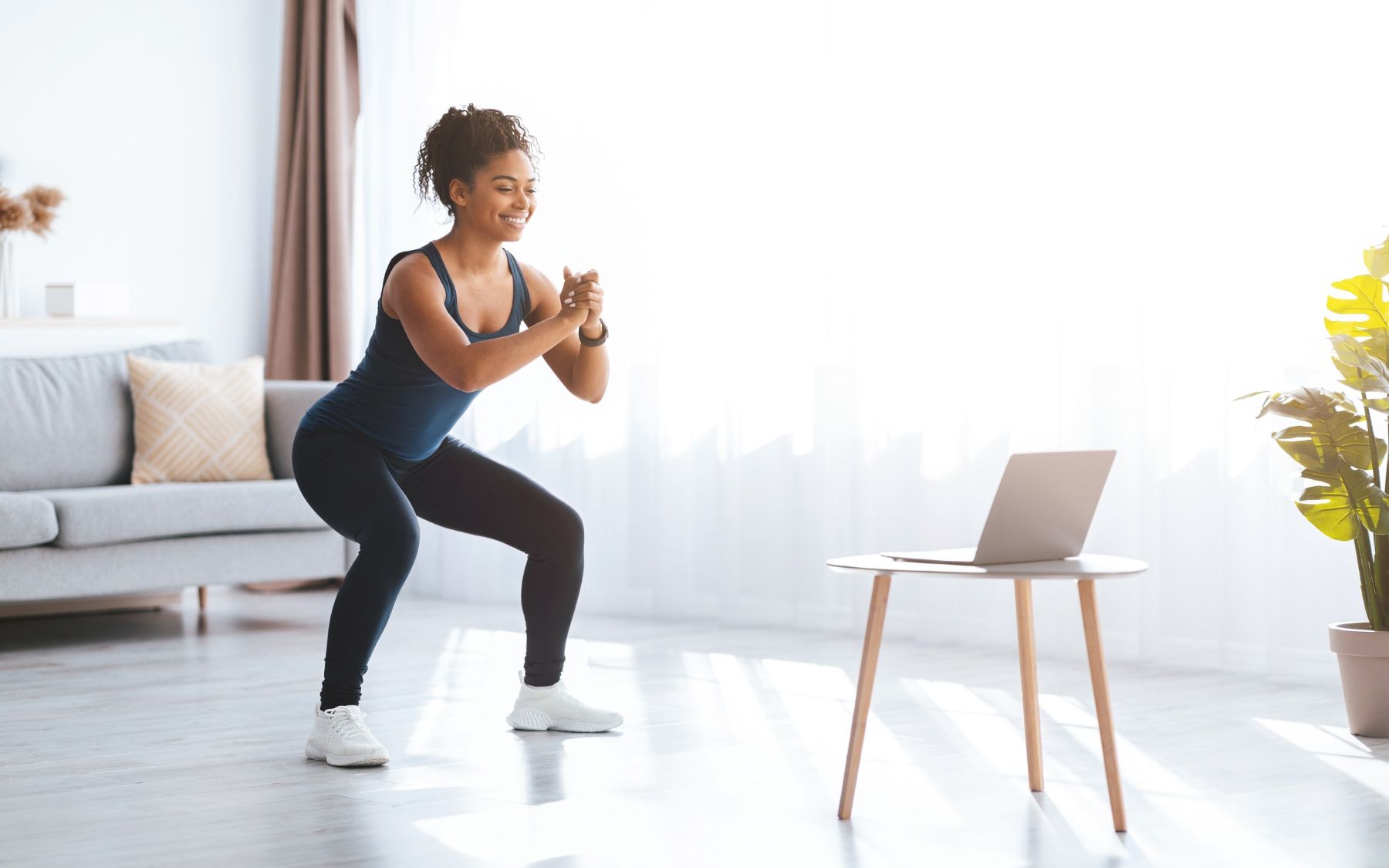
- Modify your squats – Reduce the depth, use a chair as a target or hold onto a stable support.
- Adapt your lunges – Shorten the range of movement, or swap them for sit-to-stands or supported squats.
- Try glute bridges – A great way to strengthen your glutes and hamstrings with less stress on the knees.
- Try Romanian deadlifts – Strengthen the glutes and hamstrings without requiring a deep knee bend.
What about your hips?
If your hips feel sore or stiff, focus on strengthening the muscles that support the joint, particularly the glutes and muscles around the outside of the hips. The focus should be on building strength around the hip in positions that feel comfortable and stable.
- Try clamshells – Target the muscles around the side of the hips.
- Add side-lying leg raises – Strengthen the outer hips with very little pressure through the joint.
- Try banded side steps – Work the glutes and hip stabilisers while keeping you in a standing position.
- Include hip extensions – Standing or lying hip extensions can strengthen the glutes without requiring deep hip flexion.
- Consider your stance – A very wide stance may irritate some hips, so find a foot position that feels natural.
If your feet or ankles hurt
Sore feet or ankles can make standing and weight-bearing exercises uncomfortable. You can still strength train by choosing exercises that reduce the amount of pressure going through your feet and ankles. Wear supportive footwear! Well-fitting, supportive shoes can make standing exercises more comfortable, particularly on hard surfaces. I always exercise with a good pair of trainers myself (ON, Hoka and Nike are some brands I like).
- Seated exercises – Seated upper-body exercises allow you to keep training while taking pressure off your feet.
- Floor-based exercises – Exercises such as dead bugs and lying leg raises can build strength without standing.
- Swap calf raises if needed – If lifting onto your toes is uncomfortable, keep your feet flat and gently tense your calf muscles for a few seconds before relaxing. This lets you work the muscles without repeatedly moving through the ankle.
- Avoid unstable positions – Choose exercises where both feet are firmly supported rather than balancing on one leg.
If your lower back is bothering you
If your lower back is feeling sore or sensitive, certain strength exercises may feel more challenging than usual. It’s also easy to forget about your core when your back hurts, but the muscles around your core play an important role in supporting and stabilising your body. Back pain can sometimes change the way we move and use these muscles, so focus on building strength through your core, glutes and legs with movements that feel controlled and comfortable. If your pain is persistent, do make sure you check in with a healthcare professional.
- Try bird dogs – A great way to strengthen your core and glutes while working on stability and control.
- Try a modified plank – Planks help strengthen your core without lots of movement through your lower back. Start with your knees on the floor or your hands supported on a raised surface if needed.
- Practise abdominal bracing – Gently tighten your abdominal muscles as though preparing for a cough or someone touching your stomach, while continuing to breathe normally.
- Think about your technique – Slow, controlled repetitions can help you maintain good form and avoid placing unnecessary strain on your back.
Use the 24-hour rule
How you feel after a workout can be just as important as how you feel while you’re doing it. Some muscular effort, fatigue or mild soreness can be normal, but sharp, severe or increasing pain is different.
- Check in with your body – Notice how you feel during exercise, later that day and the following morning.
- Look for changes – If your usual joint or back symptoms are noticeably worse and haven’t settled within 24 hours, you may have done too much.
- Adjust rather than give up – Try reducing the weight, range of movement, repetitions or impact next time.
- Know when to stop – If an exercise causes sharp or significant pain, or makes you change the way you move to compensate, stop or modify.
A Final Thought
Our bodies may not feel the same every day and our exercise routines don’t need to either. Some days you may feel strong and able to do more. On others, an aching knee, stiff hip or sore back might mean adapting your workout.
What matters is that you keep building strength in a way that works for your body. Modifying an exercise doesn’t make it less worthwhile and consistency over time is far more valuable than pushing through pain and needing several days to recover.
Strength training helps us maintain our muscles, support our bones and joints and stay mobile as we age. So, listen to your body, make adjustments when you need to and remember that there is almost always more than one way to do an exercise.
As always, if you have any questions please do get in touch.
Caroline x